Products & Tools
Computational Medicine Investigators and staff are devoted to developing Programs and Tools that incorporate multiple methods, including machine learning, biostatistics, semantic technology, and the modeling of biomedical systems to benefit clinical and translational research as well as patient care. Computational Medicine works to uncover new ways to advance personalized medicine and to enhance human health and wellness. We connect data to health.

BioPortal
BioPortal is the a comprehensive open repository of biomedical ontologies, providing tools to search, browse, annotate, and analyze standardized biomedical vocabulary across thousands of ontologies. It supports researchers and developers with both a user-friendly web interface and a powerful REST API for integrating ontology data into applications and workflows. BioPortal enables shared access to structured biomedical knowledge that enhances data interoperability, discovery, and analysis.
CEDAR Workbench

ChatEHR
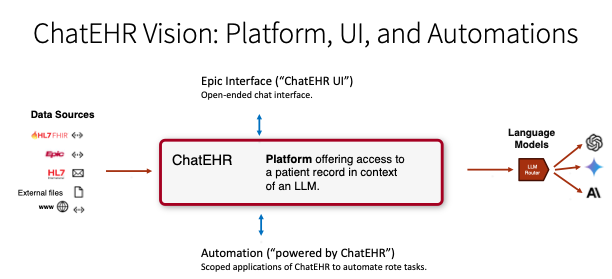
ChatEHR is a set of capabilities developed at Stanford Medicine, for using a set of Large Language Models (LLMs) with a single patient’s longitudinal medical chart in context. This innovative tool allows health care providers to securely interact with patient records through a conversational interface to ask questions of a given patient’s medical record. The capability can also be used via an API, to apply an existing set of criteria to a patient’s record for decisions about transfer eligibility, referrals to certain services, and creating summaries of a hospital course of stay.
Clinical Text De-Identifier

MedHELM
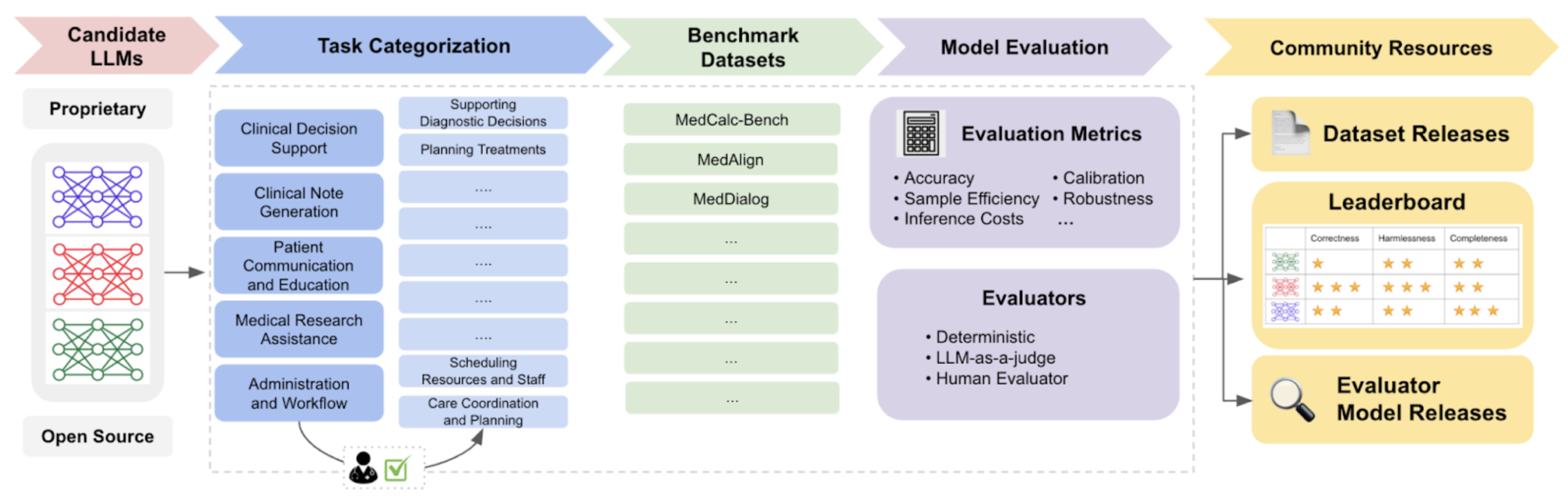
MedHELM introduces a task-based evaluation framework that shifts the frontier of healthcare LLM evaluation from traditional exam-style QA to real, clinician-defined tasks. Developed in collaboration with 29 clinicians across 14 specialties, the framework encompasses 121 tasks and 37 benchmarks. The results provide a definitive reality check: while today’s top models excel at communication and documentation, they continue to struggle with complex administrative workflows and clinical decision support. MedHELM offers the field’s most comprehensive, practice-aligned view of where LLMs are truly ready for hospitals and where they fall short.
MoTrPAC Data Hub

Protégé
A free, open-source ontology editor and framework for building intelligent systems. Protégé is supported by a strong community of academic, government, and corporate users, who use Protégé to build knowledge-based solutions in areas as diverse as biomedicine, e-commerce, and organizational modeling.
Radiology Report Explanation
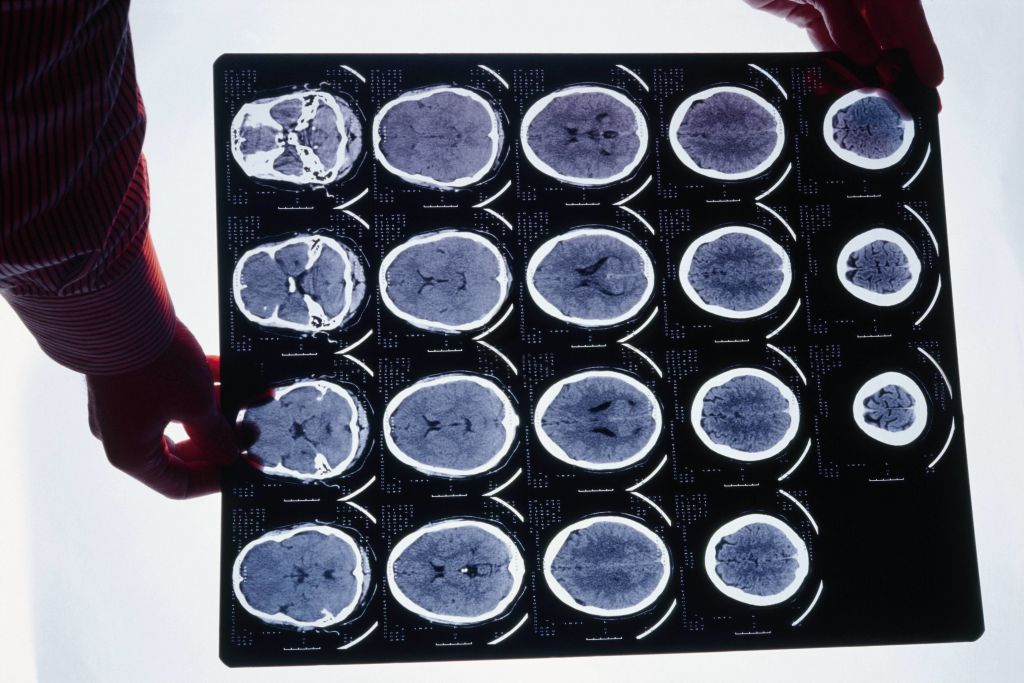
This tool uses concept extraction methods and a large language model to provide natural language explanations of concepts in radiology reports. When a report is submitted, it is returned with hyperlinks for each concept. Selecting a concept starts a dialog with a language model to explain the concept in the context of the report.
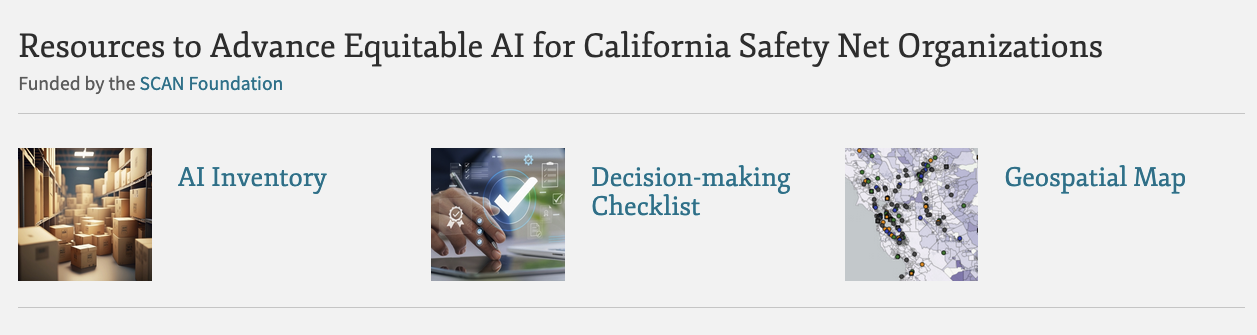
Resources to Advance Equitable AI for California Safety Net Organizations
These three tools were created as of result of research examing how artificial intelligence and machine learning (AI/ML) tools are selected, evaluated, and deployed in healthcare settings serving older adults. The work combined policy analysis, organizational assessment, and data-driven tools to characterize current AI use and identify gaps in oversight and implementation. Three resources developed include: 1) A comprehensive inventory of AI/ML algorithms used in community-based healthcare settings, paired with a summative analysis of their available documentation; 2) A decision-making checklist which evolved from interviews and surveys with healthcare leaders assessed institutional decision-making processes, governance structures, and readiness for responsible AI adoption in elder care; and 3) An interactive geospatial mapping tool integrating hospital AI/ML adoption status with clinical, infrastructural, and socio-environmental data.
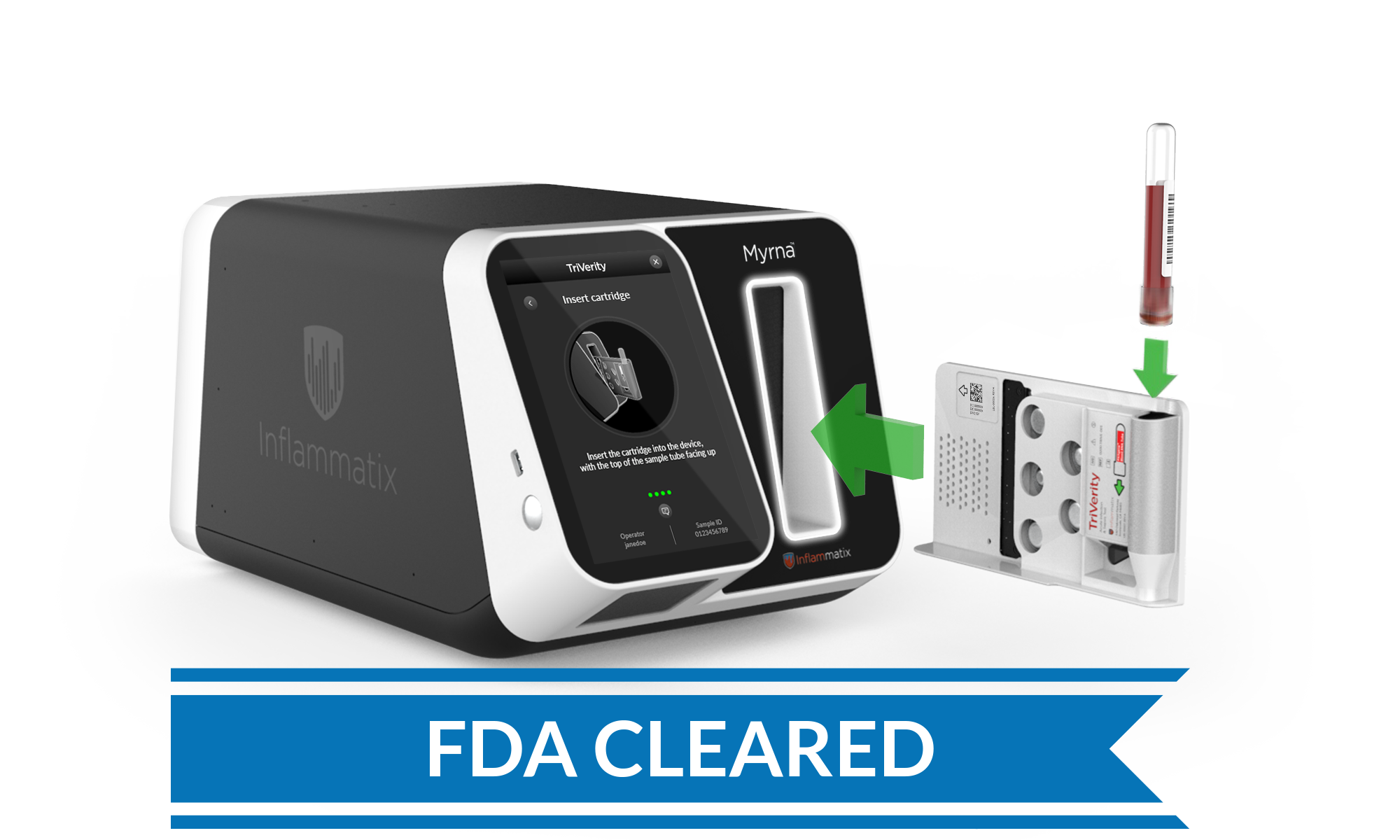
TriVerity
TriVerity is a rapid molecular test that helps doctors make better decisions in emergency and hospital care, when diagnoses are uncertain but decisions can’t wait. It addresses a simple yet profound unmet need: clinicians are regularly forced to guess in high-stakes moments because biology is invisible to them in real time. TriVerity provides diagnosis of presence and type of infection, and prognosis for severity of infection from a single blood sample in 30 minutes.